Visitors
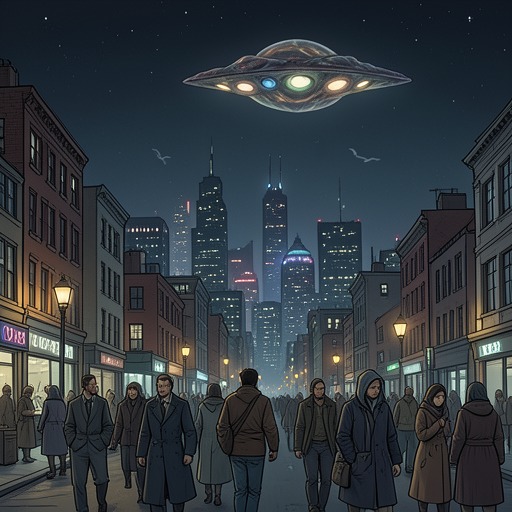
Roadside PicnicThe Visitors are the absent extraterrestrial beings at the center of the Visitation: their presence is known less through any direct encounter than through the Zones, the artifacts left there, and the human systems built to contain and explain those remains. Valentine Pilman’s roadside-picnic analogy makes their defining significance a matter of scale and indifference: what transforms human life may have been no more than discarded objects from a passing stop.
Identity and the limits of knowledge
The Visitors are understood as rational beings beyond Earth, but the evidence offers no direct account of their appearance, speech, intentions, or experience. In conversation with Richard Noonan, Valentine points to the Visitation’s implication that humanity is not alone in the universe. Yet the existence of another rational creature does not itself explain what the visitors wanted or whether they meant to communicate.
Valentine sharply separates his institutional work from the study of extraterrestrial cultures. Although he has served for two years as Canadian consultant to the UN Commission on Problems of the Visitation, he says that he and his colleagues represent the international scientific community when questions arise about implementing decisions on internationalizing the Zones. Their practical role is to ensure that the marvels found there reach the International Institute, not to claim insight into the Visitors’ culture.
The roadside-picnic analogy
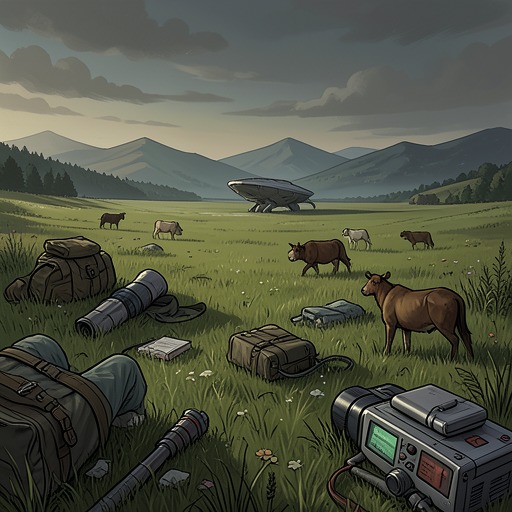
Asked what he thinks of the Visitation, Valentine tells Noonan to imagine a picnic. The visitors, in this account, stopped somewhere along a road in the cosmos and left behind ordinary debris: a penknife, torn newspapers, coins, and faded flowers gathered in another meadow. Noonan recognizes the image as a roadside picnic. Valentine’s analogy turns the Zones into the residue of an occasion that was not organized for human observers, and the artifacts into things whose presence does not guarantee that people can understand their purpose.
The analogy also unsettles the prospect of a return. Valentine asks whether the visitors will come back, but his comparison gives no reason to expect that they noticed Earth or intended to leave a message. The objects may be consequential to human beings without having been placed for them. The gap between human urgency and possible extraterrestrial indifference is central to the mystery surrounding the Visitors.
Human institutions and the Zone's remains
The Visitors’ earthly legacy passes through competing forms of custody and interpretation. International arrangements direct Zone discoveries toward the International Institute, while Valentine describes his commission’s work as addressing the consequences of materials leaking from the Zones into the hands of irresponsible people and organizations. The Visitors themselves remain beyond institutional reach; human authorities can regulate the circulation of their remnants, but not thereby master their meaning.
That circulation is not only bureaucratic. Captain Quarterblad empties a briefcase of contraband, including two small Empties, nine Batteries, and Black sprays, making the Zone’s remains visible as objects that can be carried and handled outside official channels. The scene gives the Visitors’ legacy a material afterlife among policing, research, and unauthorized possession, even as the beings associated with those objects remain unseen.
Unintended contact and the unknowable
Valentine rejects the idea that the Visitors caused humanity’s prior wars and military-industrial development. He asks how they could have known that such complexes existed, refusing to make human history an intentional prelude to extraterrestrial contact. The distinction matters: the Visitation has changed the conditions of human thought, but it does not follow that the Visitors designed those changes or acted with humanity in mind.
The same uncertainty shapes scientific use. Valentine observes that researchers have learned how to use so-so objects and the circumstances in which they multiply through a process resembling cell division, while still failing to understand the relationship between the objects and the fruit they can help obtain. Knowledge advances through practical handling without resolving the underlying logic. In this sense, the Visitors’ defining presence is also an absence: their artifacts can be classified, traded, studied, and used, while the intentions and concepts that might make them intelligible remain out of reach.